Photo workshops in Paris
by David Henry. Thanks to a teaching method developed since 2006, learn the technical subjects of photography in a succinct and efficient way and move on quickly to more exciting subjects, such as composition, framing and esthetic considerations.
Which exposure mode should I use?
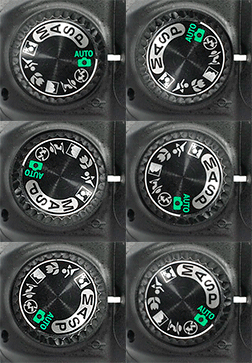
There are eleven exposure modes on this camera’s dial and each and every one of them is automatic except for Manual. Therefore speaking of “automatic mode” is meaningless, because right away that poses the question, “Which one?”. Green Mode (the completely automatic mode) is by far the worst and the “scene modes” (the icons) aren’t really any better. I use Aperture Priority 90% of the time and Manual the other 10% of the time. Learn why and how to use these modes to obtain the rendition you’d like to see in your pictures…
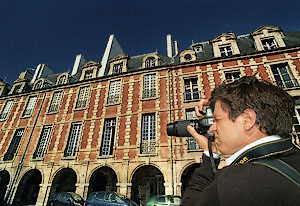
Matthieu Facq photographing building façades in place des Vosges, Paris. Taken with a 20 mm lens, a polarizing filter and the camera’s internal flash to open up the shadows.
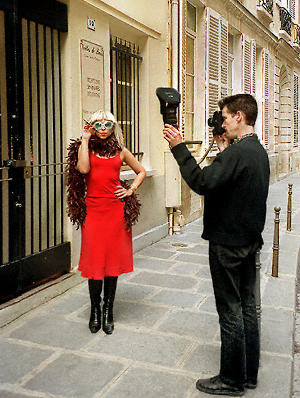
David Henry photographing Lucy in the Saint-Sulpice neighborhood in Paris. —photo by Jérôme Cohen

One of the pictures taken during the photo shoot above. Take a look at other portraits taken in Paris…
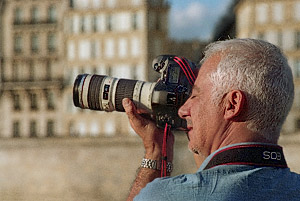
Laurent photographing in front of île Saint-Louis, basking in the late afternoon sun on the Left Bank in Paris.
Tips, hints and advice from a native English-speaking photographer constituting one of the best photography schools in Paris. Regardez cette page en français.
These one-on-one photography classes, entirely tailored to your interests and what you would like to learn, can help aspiring Parisian photographers in three ways:
 Google Guide in Paris, level 9
- from the visitor’s point of view, which places to visit and when:
- classic historical monuments: The Eiffel Tower, Notre-Dame, l’Arc de Triomphe, the Champs-Élysées, the musée du Louvre, photogenic locations that make up the visual identity of the city of Paris…
- Paris “Off the beaten path”, the odd, quirky sides of Paris that most visitors do not find out about: the Marais, parc des Buttes Chaumont, cimetière Père Lachaise, the Passages Couverts, Belleville, the Butte-aux-Cailles neighborhood, the Catacombs, the bird market, canal Saint-Martin, the chapelle de la Médaille Miraculeuse, the cat and dog cemetery in Asnières, the da Vinci Code…
- from an artistic point of view, how to take pictures:
- perspectives: how different angles can change the mood of a image, explore various focal lengths and the perspectives they give, dramatic close-ups that create images that stand out from the rest.
- timing: Predict the next movements of your subject and capture the “Decisive Moment”, the famously defining element of photographs by Henri Cartier-Bresson and Robert Doisneau.
- the time of day: the best light for photographing specific historic monuments in Paris.
- candid pictures: make yourself invisible and create pictures that transport people in to the scene you are photographing.
- portraits: flattering pictures that reveal the true character of your subject and the best settings and places to take them. Take portraits in every-day outdoor situations that look like they were made in a studio!
- nighttime photography as sharp as if they were taken at noon; the settings for best over-all exposures in the shadows and highlights.
- the electronic flash: Fill-in flash, balancing the flash exposure with ambient light, whether during the day or at night; reflectors for diffusing the flash, the best angles from which to point the flash and stroboscopic flash.
- how to “make yourself lucky”: Sometimes people say, “oh, you were lucky” when looking at one of my pictures. Perhaps, but I strongly believe that it is possible to create one’s luck. Learn to predict and put yourself where and when the action will take place minutes or seconds later.
- from a technical point of view, helpful whether you’re a beginner or a serious advanced amateur, well-used to the Raw file format, going in to more detail on exposure and other subtle yet helpful settings on your camera, how to obtain the best image quality your camera is capable of delivering, to…
- Photoshop, a program I have been using for since 1991 and Adobe Lightroom, which I’ve been using since 2009; advanced yet efficient techniques for obtaining fine art picture quality, whether your images will be printed or shown in electronic presentations, such as web pages.
What are the rates?
I’m in the habit of requesting €140 for a first session of eight hours and €100 per day for additional sessions of the same duration. For shorter meetings, I ask for €20 per hour. You can consider these workshops as an opportunity to pick my brains and ask me questions directly, which most photographers wouldn’t have succinct and effective answers to; and to put my advice into practice on the spot to ensure you’ve properly absorbed my recommendations.
Pay on-line for one workshop session
Or for second and subsequent workshop sessions
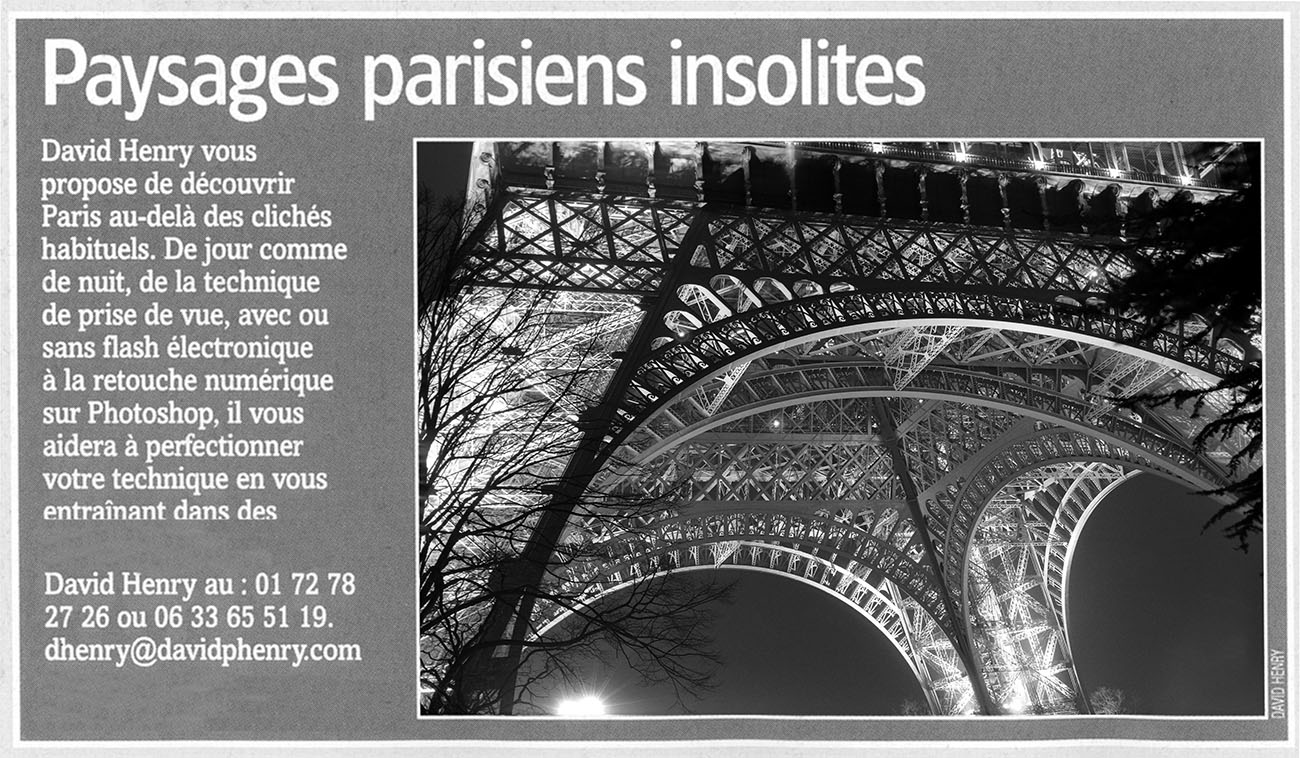
As seen in «Réponses Photo»Above: an announcement for photography lessons by David Henry printed on page 154 in the October 2005 edition of one of the leading photography magazines in France. |
Questions and answers about Paris photography workshops:
Who is David Henry?
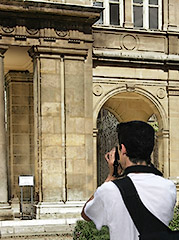 |
| David Henry taking pictures in the courtyard of the musée Carnavalet in the Marais, September 6th 2005. —photo by Linda Schenck |
I’ve been taking pictures since the age of thirteen, starting with cameras I found at flea markets, with which I had to guess the focus, aperture and shutter speed. I studied photography at the Massachusetts College of Art, with Nicholas Nixon and Baldwin Lee. I grew up and spent most of my life in Boston, Massachusetts and I’ve been living in Paris since 1996. I’ve been working professionally as a photographer since 2003 and most of my work consists of tourism and travel photography, for advertising agencies, architects, graphic designers producing books, magazines and other kinds of publications. One of my greatest successes was the series of pictures I took for the illustrated edition of the da Vinci Code. My first great love in photography has always been candids, pictures of people, in the street, doing odd, unusual, interesting things and portraits. Since I’ve been living in Paris I’ve been taking much more of the typically pretty “postcard” kind of pictures, suitable for coffee table books since there are so many take here and because they sell well, all the better. That said, candid, street photography, is still what holds my interest me the most. You may wish to take a look at an overview of the pictures I take in Paris and an article explaining how to take great pictures in Paris…
Where are these street photography workshops held?
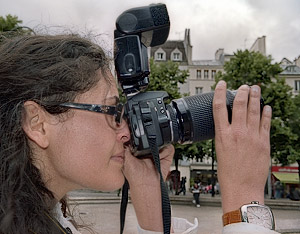 |
| Caroline Viciana photographing the fontaine des Innocents with her Nikon D40x, a 70–300 mm zoom and a SB-25 flash, June 6th 2008. |
I teach photography in the city of Paris, in the neighborhood of your choice. This mostly has to do with what kind of pictures you like to take: If you like photographing buildings and monuments, the stretch along the River Seine from île Saint-Louis, to île de la Cité, Notre-Dame, place Dauphine, pont Neuf, then on towards to the musée du Louvre is a good choice. If you like taking pictures of people, there are plenty of spots in Montmartre with lots of subjects. If you’re looking for twisty old streets with medieval atmosphere, the Marais and different places on the Left Bank and the Latin Quarter are good options. Of course, it is possible to arrange sessions in places around Paris, such as Versailles, Fontainebleau, Chartres and so forth.
What kind of camera equipment is necessary?
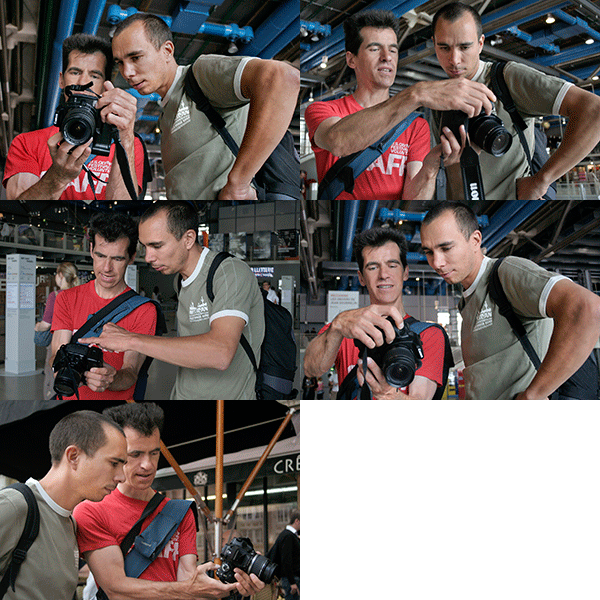 |
| David Henry discussing esthetic considerations and technical issues concerning the Canon EOS 350d with Lucas Pollonghini, July 19th 2008. —photos by Michel Enjalbert. |
Any camera, whether it be a reflex, “mirrorless”, compact or bridge is perfectly fine for learning photography as long as it has the four classic exposure modes: “PSAM”; Program, Shutter Speed Priority, Aperture Priority and Manual. Participants should bring along their favorite pictures, or those they are frustrated with and any accessories they would like to learn more about: electronic flash, wide angle, telephoto or zoom lenses, tripod, etc. If you do not have a camera that allows manual exposure, you can use my Nikon D90 DSLR.
How many students are there per workshop?
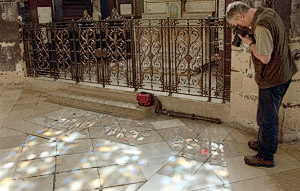 |
| Rick Motschall taking pictures of spots of colored light projected by the stained glass windows of église Saint-Eustache, September 11th 2006. |
There is just one participant: you! That is, unless you would like to participate with friends, in which case the rates are the same. These photography workshops are entirely customized, one-on-one sessions. You may think of these sessions as an opportunity to learn techniques I have gathered over the decades, to benefit from years of experience gained doing photo shoots for publication, learn the advantages and disadvantages of different kinds of photo equipment and to “pick my brains” and ask specific questions that most people wouldn’t have the answer to.
What is the most important accessory for taking the best quality pictures?
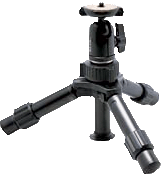
I strongly recommend a “tabletop” tripod, the best of which is the Slik Mini Pro III which weighs 11 ounces. It might seem a bit stodgy and old fashioned taking pictures on a tripod when camera manufacturers are flaunting sensitivities of ISO 6400 and higher, but blurry, noisy photographs, with little depth of field aren’t very rock & roll either: Using a tripod allows you to stay at ISO 100 and stop the lens down halfway because the shutter speed is of no importance. It can just as well be one second, ten seconds or thirty seconds. Aside from that, this tripod allows you to shoot smoother videos with an electronic viewfinder camera by placing the legs against your collar bones and chest.
What is the other pertinent accessory?
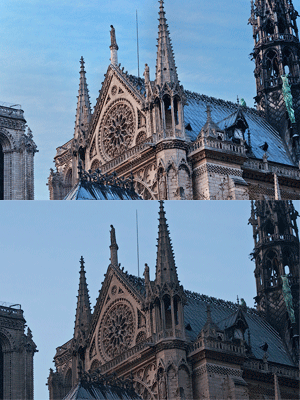 |
| The polarizing filter darkens the sky, automatic exposure will take the picture brighter to keep the same brightness in the sky and thus the rest of the picture becomes brighter. I promise, these pictures of Notre-Dame are shown the way I took them, with and without the polarizing filter, without modification in Photoshop. |
I highly recommend buying a polarizing filter to make the blue skies darker, more saturated and to cut glare on glass, reflections on water, painted or metallic surfaces, the leaves of plants, bushes, trees, etc. One can quite easily brighten the foreground in pictures like this on the computer though in a picture taken with the polarizing filter, the work is already done, better. This filter is not so expensive and is quite small & light so you might as well get one. Since the polarizing filter cuts one or two ƒ stops of exposure, it can also serve as a “neutral density” filter allowing for slower shutter speeds so you will be able to “capture” action. From $40, depending on the diameter, in most camera stores.
Do I know your camera?
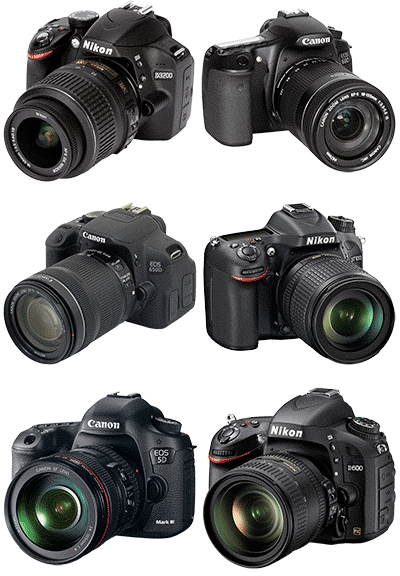 |
| Entry level and mid-range Nikon and Canon cameras: the D3200, D7100, D600, 650D, 60d and the 5d Mark III. |
I bought my first Nikon in 1982, I went digital when I bought a D90 in 2008, I purchased a D600 in 2012 and a D800 ten years later and I know all of Nikon digital reflexes like the back of my hand from having taught photography since 2006. I know all of Canon’s SLRs except their most expensive models, such as 1D and 1Ds and I’m quite familiar with the most subtle of settings on Canons and Nikons, as well as the “culture” of each brand. I know Sony, Pentax and Olympus cameras almost as well, though after all, a camera is a camera and compromises having to do with image quality will always be the same: shutter speed, sensitivity, apertures and depth of field, whether it’s a Lumix, Samsung, Fujifilm, Sigma, Leica, a pocket camera, an SLR, a medium format camera or a field camera, etc.
What about white balance?
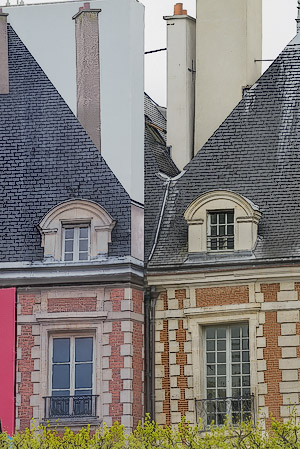 |
| White balance Fail! A photograph printed on a building construction site tarpaulin that is much too cold and red, a mistake that is easily seen because it was mounted to the left of a building façade of similar colors above the Café Hugo in place des Vosges. This rendition of colors is very typical of Canon digital reflex cameras; it’s amusing to see how many color-blind photographers there are these days. |
White balance is a term quantifying to what extent a picture is warm or cold, blue or yellow. Automatic white balance on cameras made before 2011 would generally take photos too blue and cold during the day and wouldn’t correct sufficiently at night under artificial light. Automatic white balance is much better on cameras made after 2011, though it might result in images that are too cold during the day and too warm at night, this isn’t a problem above all if you take pictures in the Raw format. I use manual white balance so as to record the true colors of the stones inside a building because I’ll just about never be able to return and see what the ceiling of a church looks like and to take pleasing portraits at night, avoiding a hot color rendition on peoples’ faces so they’ll be pleased when looking on my camera.
How long are these street photography Paris sessions?
I’m in the habit of starting at 11:00 am and carrying on until 7:00 pm, though we can start whenever you wish: lessons can be arranged any time: the morning, at night, during the week, the afternoon, on weekends.
Photography tours
Photo walks are halfway between a traditional photography workshop and a classic guided tour of Paris, less focused on the technical subjects of photography. They are intended for people who:
- Either know their camera and technical subjects of photography well but would like to learn the more subtle points of digital photography, discover the neighborhoods of Paris, the history of the city, accompanied by a professional photographer, see how he goes about photographing it and receive feedback on the photos they take;
- Or they have compact camera that are not very powerful, on which options and settings are not going to make much of a difference in image quality anyway. They simply want to learn how to easily take beautiful images wherever they travel, avoid the pitfalls of banal photos, all the while discovering the beauty and history of Paris.
My opinions on photographic composition and framing…
|
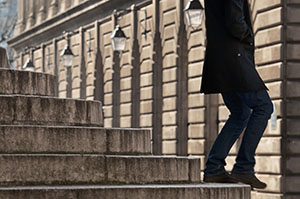
I figure it’s best to carefully look at everything that is not the subject: the subject of a photo will take one third, a half or two thirds of the image, there will always be one third, one half or two thirds of the picture that is not the subject. It is also necessary to look at the background to make sure it makes sense as concerns the subject, that everything behind will set off the subject nicely so there will be a good juxtaposition between the subject and background.
To see, to know how to anticipate subsequent events and be at the right place at the right time, I feel it’s important to keep both eyes open while looking in the viewfinder to stay aware of who or what might come in to the frame and predict what your subject will do next, all the while watching the edges and corners of the frame to create an effective composition, looking at the internal structure of the image, to ensure that there is something to look at everywhere in photograph and avoid empty regions.
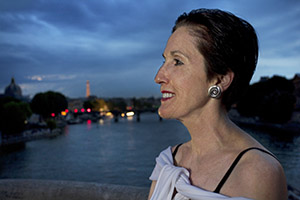 |
| A pleasantly out of focus background behind your subject makes them stand out from their surroundings. |
Learn how to manage depth of field
A good dose of “bokeh” around a face will give your pictures a 3D look. Cameras and lenses made since 2012 take photos that are wildly sharp, thus when taking portraits it’s good idea to emphasize this sharpness with a shallow depth of field and an out of focus background: By doing so the your subject will “jump out” of the picture, which oddly gives more depth.
Why take a photography workshop in France?
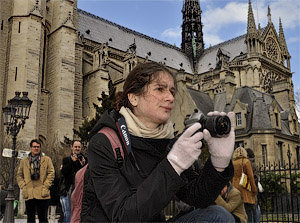 |
| Amandine taking pictures of people doing acrobatic tricks on roller blades in front of Notre-Dame with her Canon EOS 300V, March 8th 2009. |
Photography has enjoyed quite a renaissance since 2004. From the mid-1980s through the end of the 1990s, photographic technologies weren’t advancing that much because so much progress had already been made. There wasn’t much difference between a single lens reflex from 1983 and one made in 2001. Digital cameras are the norm these days and many people are buying a camera for the first time, or the first time in the last ten or twenty years. Traditionally, there were three kinds of film: black and white and color negative and slide film, while with current cameras, people will be interested in learning about white balance, sensitivity, resolution, file formats like Jpeg, Tiff and Raw and many other technical issues. Acquiring a new camera makes people want to brush up on their picture-taking, learn how to take the best photographs, technically and esthetically and get their money’s worth with the best image quality their camera can provide.
What to do when it rains, when it’s cold, or when there’s no sun?
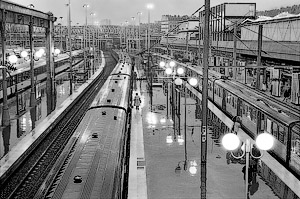 |
| Train tracks at gare du Nord: Even with the worst of weather, it’s always worth heading out to take pictures. |
Naturally, we all prefer to take pictures on nice sunny days, however, taking great pictures on cold or rainy days can be a rewarding challenge and certainly, there are plenty of impressive pictures in the history of photography taken during not the most “appetizing” of weather.
When it rains it’s necessary to dress warmly and go out with a (big) umbrella. One trick is to search out glistening reflections on the streets and sidewalks, often from neon signs of cafés, bars and tobacconist shops, or monuments and people.
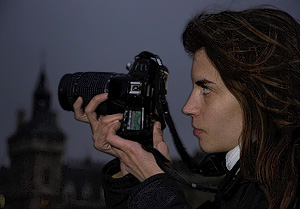 |
| Laura taking pictures of the Conciergerie on the pont d’Arcole, with my Nikon F70, October 28th 2008, taken with her Nikon D80 and my SB-26 SpeedLight flash. |
When it’s cold, once again, one should dress warmly. I spent most of my life in Boston, where it’s 20°F at high noon every day for a week in February and the temperature rarely rises above freezing in December, January and February. If you’re truly frozen to the bone, we can always go in to a centuries-old church and learn about low-light photography, with the tripod. What’s impressive is to see how much more is visible in such pictures, as compared to the naked eye.
When the sky is completely clouded over, (which is typically worse than rain…), one solution is to wait until nighttime, when Paris turns in to the City of Light. Aside from all this… voilà, most of us do prefer taking pictures in the spring, summer and fall. Except it’s better to stay in artistic activity all year long and know how to make engaging images no matter the weather.
Is a digital reflex camera necessary to participate?
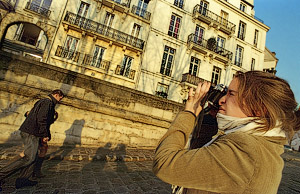 |
| Elsa Bonnefoi photographing façades with her Canon AE-1 on quai de Bourbon, île Saint-Louis, an hour before sunset on March 12th 2007. |
Whether you have pocket camera, bridge camera, a reflex, or a film-based camera is not important, any camera made since 2012 is capable of taking pictures of very good, if not excellent quality: you can’t go wrong. I can lend you my Nikon D90 if you do not have a DSLR, or in any case, taking pictures with a pocket camera or a bridge will certainly allow you to learn how to properly use a reflex or a “large sensor hybrid” later on. Do remember to fully charge the battery the day before as I’ve found they get tired easily during workshops while looking over settings, options in the menus and reviewing photographs as we take them. If you would like to learn how to improve pictures with a computer you may wish to look over a page about Photoshop workshops.
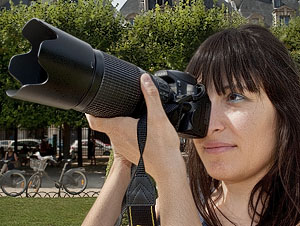 |
| Gulsen taking pictures of a fountain in place des Vosges with her Nikon D3000 and my Nikkor 70–300mm zoom, August 22nd 2010. |
What previous skills and knowledge are required for participants?
I work with people of all kinds of skill levels, from absolute beginners to people who know more than I do in certain ways. Participants need not know anything about photography, the only requirement is a desire to take pictures, a will to learn, the energy to do creative exercises in the field and the motivation to put in to practice the ideas and concepts I teach.
When are the photography workshops held?
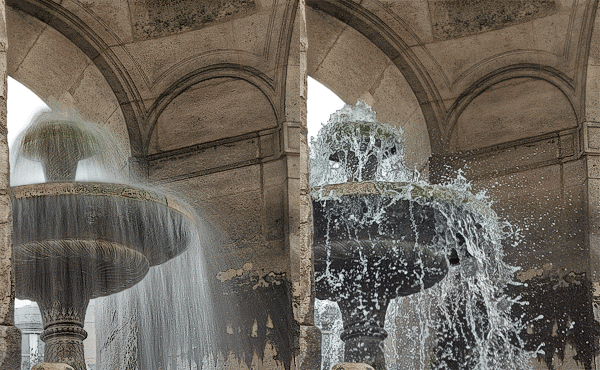 |
| For the most part everyone prefers pictures that are Tack-Sharp! In any case, on a cloudy day one can either “capture” action, or freeze action. I took these photographs of the fontaine des Innocents with shutter speeds of four seconds, one third of a second, a 1/50th of a second and 1/500th of a second. Learn how to obtain the shutter speed which will give you the effect you are seeking in your photographs; see these pictures larger… |
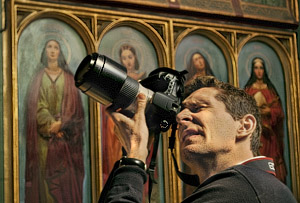 |
| Jean-Baptiste Labelle taking pictures of saints inside Saint-Gervais church with his Canon EOS 30d on March 30th 2009. |
Workshop sessions are in no way pre-organized, they are scheduled according to your availability. It is best to reserve sessions a week or two in advance, to make sure I will be in Paris and not previously engaged.
What about the French language?
Have no fear, I’ve been living in Paris since 1996 and I am very fluent in French, especially as concerns photography and computers. I’m very much at ease switching between the two languages, which comes in handy when you’d like to ask permission to take peoples’ picture.
What if I would like to give the gift of photography lessons?
It happens often that people reserve photo workshops with me as a gift for their friends. So as to make the gift-giving easier, I can send you a “Certificate good for # days of photography workshops”, personalized with your friend’s name.
How to reserve a Paris photography tour?
The easiest way to arrange an appointment is to contact me by e-mail. That way I can put you on my calendar directly by copying and pasting, everything is in black and white with no chance of error.
Some testimonials…
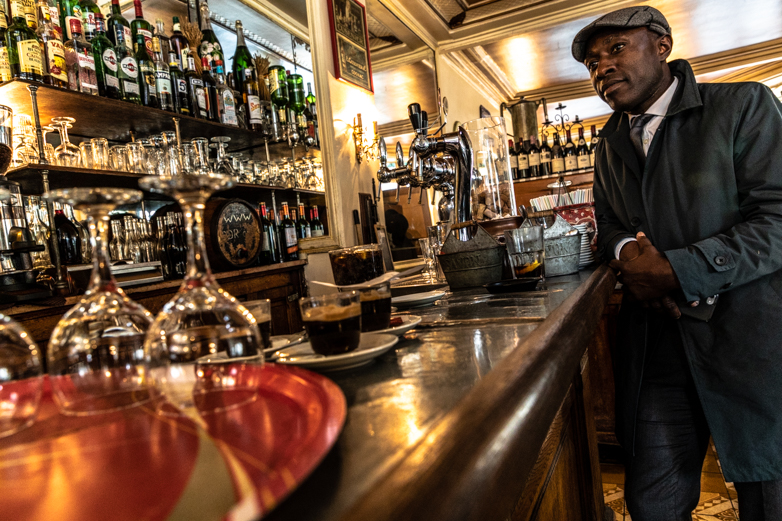
Photographs taken by Justine Kirby: a man at the bar inside the café Louis-Philippe opposite île Saint-Louis, ventilation ducts on the roof of the Pompidou Center and neon light signs inside the museum.
Justine Kirby:
I spent several hours in a private workshop with David when I recently visited Paris. I measure the success of such workshops by whether I learn new things that I can put into practice, not by how many pretty pictures I get on the day. By that standard, it was a resounding success. (I got some good pictures too, but those were an added bonus!)
Alas, the forecast was for rain pretty much all day so I set out for my appointment with David wondering how things would pan out. To start, we spent some time in a café, discussing many matters to do with photography. By playing around with my camera (although David’s a Nikon person, he knows his way around Canons), David showed me some helpful settings that I didn’t know about.
Despite the uninspiring weather, we walked around both outside and inside various places, shooting and talking about photography as we went. David really knows his stuff and is enthusiastic about sharing his knowledge with others. As well as our conversations, I learned a lot by watching him at work as he shot too. For example, I have only a full size tripod, but after watching David use a table top tripod in various settings, I appreciated how a table top tripod is often the better option. I also learned new techniques for shooting candids, for using my flash and for nighttime photography.
As well as the day itself, David was very prompt in responding to my emails to set up the workshop and helpful in responding to an email after the workshop when I sought clarification about something in my notes I had taken at the time.
I came away with lots of practical knowledge on camera settings, equipment and technique that I can immediately put into practice. So I thank David for not only an enjoyable afternoon on what would have otherwise been just a rainy Parisian day, but also for advancing my photography.
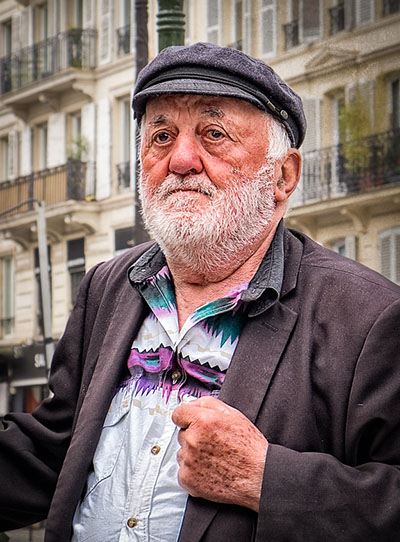
One of the candid pictures Graham Budd took, of a man standing next to the Saint-Paul Métro station entrance. Subsequent experience has shown me that this guy is wildly allergic to being photographed, he hides whenever he sees a camera even vaguely pointed towards him.
—Justine Kirby, November 29th 2018
Graham Budd:
I came across David’s web site when researching Paris Photography workshops and was impressed with his quick response to my inquiries. So in May of 2015, when I spent a week in Paris visiting and photographing the famous landmarks and museums with my wife, I reserved two of those days to get away from the crowds by walking the streets of the Marais experiencing Parisian culture and learning the art of street photography with David.
A workshop with David is a unique experience. Our day began at a quaint corner cafe where I was pleasantly surprised to learn there were just the two of us. This compared to North America where I have seen workshop attendance top 20 or more. We spent about an hour reviewing my camera and its settings after which we planned our time based on my expectations and preferences. Then we set off to explore the unique personality of the Marais.
Paris is a wonderful city to photograph but bringing home more than the typical iconic shots (although everyone needs some of those) can be challenging unless you are fluent in the both the language and the culture. Tourists with cameras, cell phones and the ubiquitous selfie sticks abound, access to buildings has become more restrictive and many of the residents prefer not to be photographed. If you want to maximize your time behind the lens and get good results, knowing where and when to go, what is allowed and how to approach and communicate with those in authority is paramount. David represents a stress free way to accomplish all of this.
It quickly became apparent that he is as passionate about Paris as he is about photographing it. He blended an extensive guide to the city and its rich history with professional photographic instruction and his knowledge of the language and customs was most helpful. Several times we veered off the main street into narrow passageways leading to secluded and beautiful garden courtyards privy only to someone with local knowledge. We also visited some of the lesser but no less interesting museums that catalogue the history of the city and his guidance surrounding some of the extra security within the Jewish district was reassuring.
During our time together David was most accommodating dividing our workshop into a day shoot followed by an evening excursion the next day. He only stopped when I was too tired to continue and is especially well versed on where to get good value should you decide to stop for a coffee. He also tailors his instruction to match the needs of the student, novice or accomplished.
If you are interested learning about Paris and its history and improving your photography skills shooting the Louvre, the Eiffel Tower or just wandering the back streets of the Marais, you would do well to contact David and check his availability.
—Graham Budd, June 28th 2015
Linda Schenck:
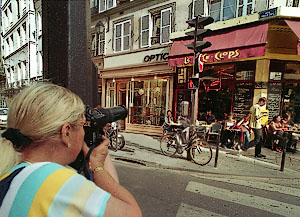
Linda Schenck taking pictures of the Pick-Clops Café on a sunny September day in the Marais, Paris.
This past September I went to France to paint in Provence. While preparing for the trip I decided that I’d like to take my new Canon digital SLR with me and take some, hopefully, great photographs.
At the last moment I decided to check on the Internet for a photography instructor in Paris. The first thing to pop up was David Henry, photographer. I e-mailed him requesting a lesson from him and after a couple of e-mail exchanges I was set.
We met up in the Marais at a café in place des Vosges so we could discuss photography and Adobe Photoshop so he would know what I already knew and what he could teach me. He reviewed with me the settings on my camera and explained the different exposure modes: manual exposure, manual focus and color modes (sRGB vs Adobe RGB). We also discussed Photoshop and I was amazed at David’s grasp of this software.
I could have sat with him all day learning some of what he knew about Photoshop but I needed to learn how to use my camera to my best advantage. So we went for a walk through the Marais and came across the musée Carnavalet, where we took some photos and David recounted some history of the museum as well as more hints, tips and advice on my camera.
After several hours we stopped at Pick-Clops café for coffee and David reviewed what he had been teaching for the last few hours.
And my instruction didn’t end there. When I returned home I e-mailed a couple of my photos to David for his advice on how to improve them in Photoshop and he looked them over and made suggestions and e-mailed them back to me, with his improvements to show me how to get the most out of the photos I’d taken. I learned more in half a day of shooting side by side with David than I have reading photography magazines for a year!
—Linda Schenck
Rachel Hofer:
I travel to Paris at least twice a year and am always looking for something new and interesting to do each time I go. This past fall, I was taking photography classes at home, but also wanted to learn more about night photography during my trip. I found David online and it was extremely easy to set-up a workshop. Before even leaving DC, we had exchanged detailed e-mails on my experience level as well as what I hoped to learn during the workshop. I really wanted to focus on long exposures and night photography and have to say, I took my photography skills to an entirely new level after only five hours on the streets of Paris with David.
The weather was warm, but a bit rainy the day of the workshop so we went into Notre-Dame as we were walking by. Since flash is not allowed inside, it was the perfect place to learn how to use longer exposure times to capture images with the low light. We were using both digital and manual SLR cameras and David’s knowledge about both is extensive.
After an hour or so in Notre-Dame, the sun had gone down and the rain had stopped, we headed over to the river by Hôtel de Ville, another favorite spot of mine and focused on capturing the beautiful architecture of Paris illuminated at night. We used small tripods along the bridge and captured not only buildings, but people in motion.
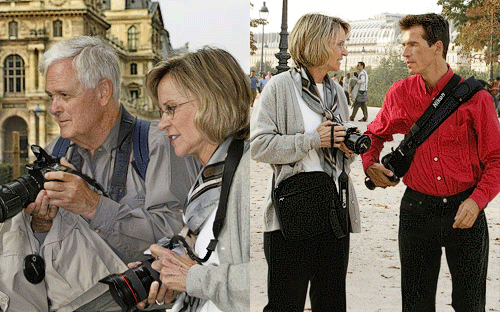
Tom and Nancy Donahoe taking pictures of sparrows; Nancy discussing composition with David, in the jardin des Tuileries, September 17th 2006. —photo by Linda Schenck.
During the entire workshop, I not only learned more about photography and my camera, but also about the history of Paris. I would highly recommend David’s workshops to anyone who loves photography and wants to take home some truly unique pictures of their visit to Paris.
Tom and Nancy Donahoe:
Nancy and I spent a Sunday with David walking through the Marais district and, in late afternoon and evening, through the jardin des Tuileries and the Louvre. We found wonderful places, people and street events to photograph. David worked with us to ensure that in doing street photography we took our shots quickly, carefully and as unobtrusively as possible. He emphasized finding the right position for the camera on an axis which he calls XYZ—horizontal, vertical and distance from the subject. He also illustrated the discrete use of fill-in flash when doing street photography. In his workshops, David will adapt to whatever area of photography the student wants. He knows Paris intimately so even if you think you know what you are looking for, David will find some delightful locations to photograph that you had not anticipated.
—Tom and Nancy Donahoe
Nick Gorevic, a workshop participant in July 2006, has started his own photography web site.
Take a look at pictures by Stéphane Pestourie, taken during his workshop on November 9th 2007 with his Canon 400d in the jardin des Plantes.
Go to the home page of my web site
Enter the gallery of pictures of Paris
See the pictures I’ve taken in the United States
Take a look at the pictures I published in the Traveler’s Companion series of tourism/travel guide books, pictures of Canada, New England and Mediterranean France
Jetlag and culture shock: Read my thoughts on what it is like taking pictures in Paris
See the pictures I’ve taken in England
Take a look at the pictures I have taken on trips to Italy
Photoshop lessons in Paris: learn how the pictures on this web site were prepared…
Portraits in Paris: with your family, friends and loved ones in the City of Light and the famous monuments of Paris in the background.
See the pictures I took on a trip through Alsace-Lorraine
What does all this new technology mean for photographers? Read my thoughts on digital photography.
Take a look at the pictures I took on a trip through Switzerland
See the pictures I’ve taken elsewhere in France
|
Write me a note if you would like to find out more about my work, or are interested in publishing my pictures. |
All images are © 2026, David Henry, all rights reserved. Written permission is required for any use.